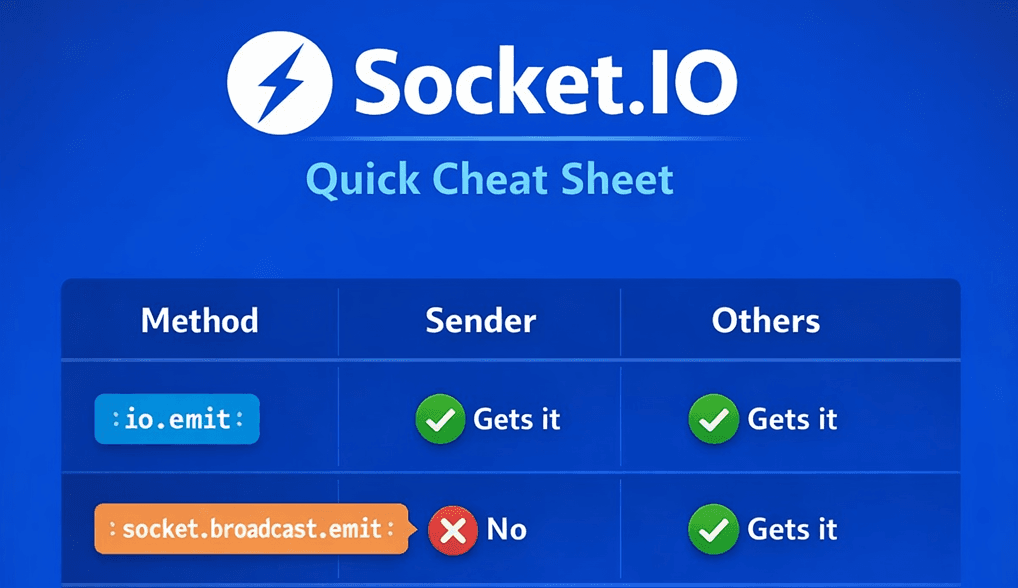
Let’s break it down cleanly (Socket.IO context).
1️⃣ io.emit
Sends the event to everyone connected
Including:
- the sender
- all other clients
- all rooms (unless scoped)
io.emit("message", "Hello everyone");✅ Sender receives it ✅ All clients receive it
Use when:
- global notifications
- system-wide updates
- chat messages where sender should also get the event
2️⃣ socket.broadcast.emit
Sends the event to everyone except the sender
socket.broadcast.emit("message", "Hello others");❌ Sender does NOT receive it ✅ All other connected clients receive it
Use when:
- sender already knows the action
- avoiding duplicate UI updates
- typing indicators, presence updates
3️⃣ Room-specific versions (very important in real apps)
Emit to a room (including sender)
io.to("room1").emit("message", "Hello room");Broadcast to a room (excluding sender)
socket.broadcast.to("room1").emit("message", "Hello room");4️⃣ Visual mental model 🧠
Clients: A (sender), B, C

io.emit           → A, B, C
socket.broadcast  → B, C
5️⃣ Common mistakes 🚨
❌ Using io.emit for chat messages and then wondering why sender gets duplicates
❌ Forgetting broadcast in collaborative apps (cursor move, typing…)
❌ Not using rooms and spamming all users
6️⃣ Quick cheat sheet 🧾
| Method | Sender | Others |
|---|---|---|
io.emit |
✅ | ✅ |
socket.broadcast.emit |
❌ | ✅ |
io.to(room).emit |
✅ | ✅ (room only) |
socket.broadcast.to(room).emit |
❌ | ✅ (room only) |